INTRODUCTION
This document has been produced by the British Independent Reinforcement Fabricators Association (BIRFA), for the use of buyers and specifiers of steel reinforcement products on Sustainable Construction projects in the UK.
Action Note PPN 11/16 was produced by the Crown Commercial Service (CCS) to give guidance in the procurement of steel for major projects, whilst addressing barriers that might prevent UK steelmakers from competing effectively for public sector contracts. This document considers the particular situation for fabricated reinforcing steel for concrete.
Reinforcing steel used in the UK is all fabricated within the UK, but can be supplied down either of two supply chains:
- an integrated route, where steel, manufactured by the sole UK reinforcing steel producer, is fabricated by tied companies within the same Group.
- an independent route, where steel, manufactured by a range of fully CARES certified companies in the UK, EU or elsewhere, is processed by one of a number of CARES approved, UK based fabricators.
PPN 11/16 has been interpreted, in some cases, as meaning projects must use UK melted steel. This is NOT the case, and the CCS stresses that procurement decisions should always be made on a quality/cost/risk basis.
In the following sections we will show that only by using the full spectrum of steel sourcing can risk be minimised, and that this can be achieved without compromising quality or sustainability.
BACKGROUND
Until 2008, the UK had at least three primary manufacturers of reinforcing steel, with domestic supply constantly exceeding demand, and the UK being a nett exporter.
Since 2012, the UK has had only a single primary manufacturer of reinforcing steel, so that demand continually exceeds supply, with the UK becoming a nett importer. Figure 1 shows how the balance of supply of reinforcing steel in the UK has changed, and that we now live with a nett deficit of around 50% of total market demand. Existing UK reinforcing steel manufacturing is operating at close to capacity, and any increase in capacity is likely to be at l
east three years away. A recent BEIS report forecasts UK reinforcing steel demand to increase, year on year, by 2.6% until 2030, by which time import demand will be around 0.75m tonnes.
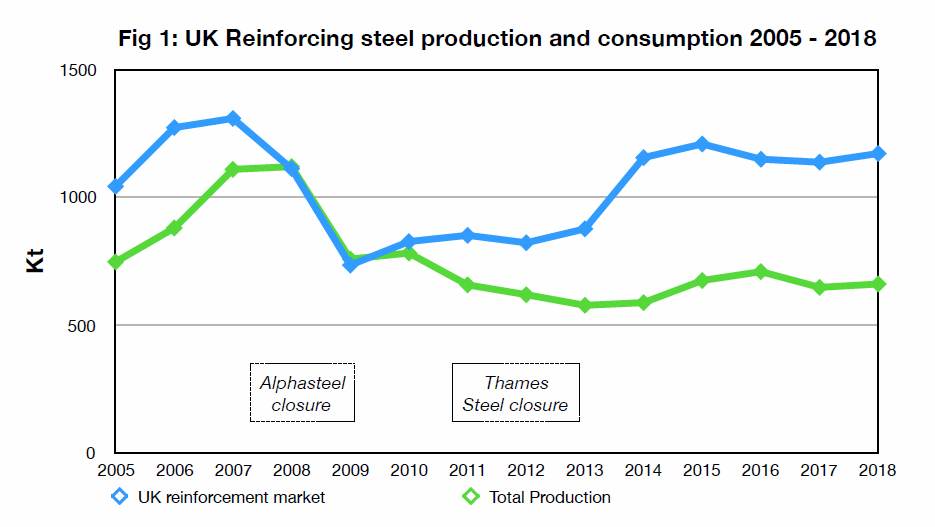
It is clear that, to strengthen its supply chain, the UK needs more steelmaking capacity for reinforcing steel, but this will take some years to develop. Meanwhile, the UK needs to further its established links with overseas suppliers. The most regular suppliers have already invested in achieving the necessary certification for the UK market, and in developing the particular products that the UK requires especially bar in coil and 500C grade.
Typically, major projects (those in excess of £10m) account for up to 90% of UK reinforcing steel demand and are therefore reliant on imported steel. It is important that contractors have confidence in the quality, sustainability and reliability of these imports. PPN 11/16 was intended to help promote a level playing field for the supply of steel to major projects. Although its origins lie in trying to protect the domestic steel industry from imports, the UK industry is demonstrably unable to satisfy more than about 50% of demand.
The guidance notes to PN11/16 identify nine key social issues relevant to steel procurement for major contracts. Some of these are more relevant to reinforcement fabrication than others, but we will now show how BIRFA members address these issues, and that they can offer a more secure supply chain through a wider steel supply base.